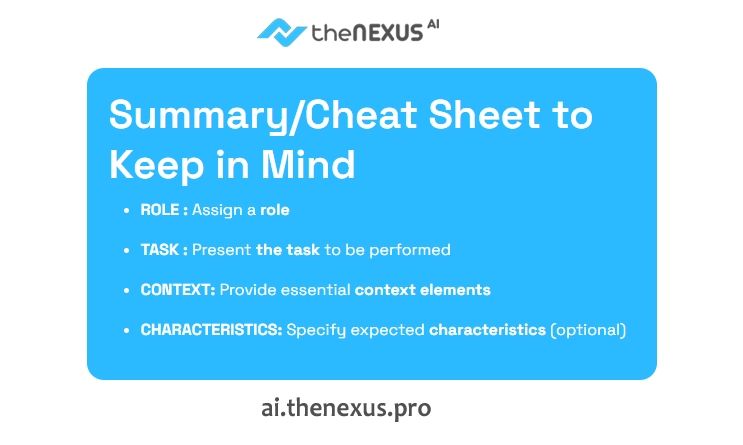
 CONTEXT : Start with clear context
Providing comprehensive context sets the foundation for accurate results. Imagine trying to cook a complex recipe without knowing the cuisine or the occasion—context helps the AI understand exactly what is needed, just as a chef needs to know more than just the ingredients.
The AI needs to know what task it’s handling, who it’s helping, and what background information is necessary to understand the request. Think of it like briefing a human assistant—context ensures they understand the scope of the task.
Key Information:
-
The context of your business, your cooking recipe, etc. (e.g., the industry or the ingredients available)
-
The objectives of the task to be completed (e.g., promoting an offer)
-
The characteristics of the target audience (optional)
-
Specific examples of the task to be performed (e.g., copy/paste a blog post or emails that you have written, etc.) **
EXAMPLE :
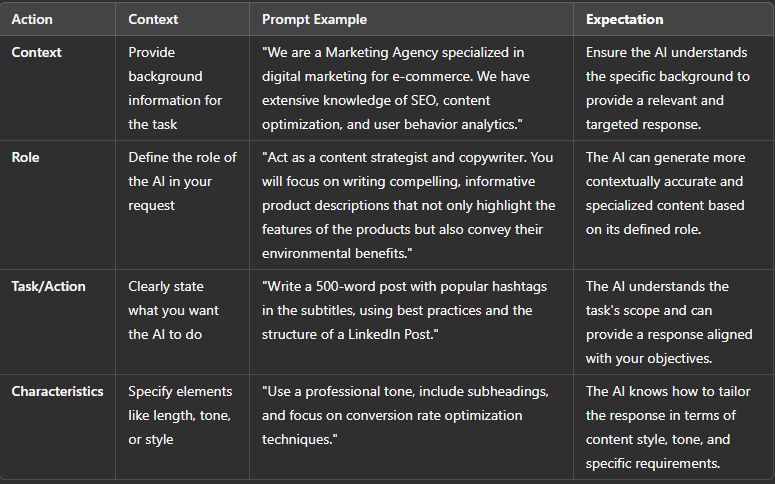
“You are an AI assistant tasked with helping an e-commerce company improve their digital marketing efforts. You specialize in SEO, content optimization, and understand the latest trends in user engagement and analytics.’ This ensures the AI has the necessary background to produce targeted and effective responses.”
This level of detail ensures the AI understands the overall goal and its specific expertise.
ROLE : Define the AI’s Role
Defining the AI’s role adds another layer of clarity, much like assigning a specific role to a team member in a project. By giving the AI a defined role, you ensure it frames its response in the context you need. For example, whether it’s acting as a professional marketer, a creative writer, or a technical expert, having this role clearly defined allows the AI to deliver responses that are consistent with the expected expertise and tone, ultimately making the output more relevant and effective.
EXAMPLE :
“Your role is to act as an SEO specialist and content strategist. You will focus on optimizing product descriptions for search engines by including relevant keywords and following best practices for on-page SEO. Additionally, your content should be informative, highlighting the product’s features and benefits while appealing to eco-conscious consumers and aligning with the brand’s mission of sustainability.”
This sets expectations and ensures the AI tailors its output to the needs of the business and its target audience.
TASKS : Be specific with Objectives/Tasks/Action
The clearer your objective, the more accurate the AI’s response will be. For example, a vague objective like ‘Write about marketing’ might yield generic content, while a clear objective like ‘Write a 500-word blog post on the benefits of content marketing for small businesses, including real-life examples’ provides specific direction and improves the output. Avoid vague instructions by specifying exactly what you want the AI to do, including structure and desired outcomes.
EXAMPLE :
“Write a blog post on how AI can improve e-commerce product descriptions to drive higher conversion rates. The post should be divided into clear sections with subheadings such as ‘Understanding Consumer Behavior,’ ‘The Role of Personalization in Product Pages,’ and ‘How AI Optimizes SEO for Product Descriptions.’ Each section should explain how AI contributes to more effective marketing strategies and should include real-life examples of successful implementations. End the post with a call to action for businesses to adopt AI solutions.”
This objective gives the AI a clear structure to follow and ensures the response is comprehensive and on-point.
CHARACTERISTICS
Including details such as tone, audience, and style will help shape the AI’s response to your exact specifications. For example, a prompt that lacks details like ‘Write an email’ will produce a generic response, while adding specifics like ‘Write a friendly, 200-word email to persuade eco-conscious customers to try our new product’ leads to a much more targeted output. The more precise you are, the better the AI can craft a response that meets your needs.
EXAMPLE :
“800-word, email template aimed at persuading potential clients to sign up for our AI-powered product description service. Use a professional yet approachable tone that conveys the value of personalized product pages. Highlight the most important points. The email should begin with a compelling hook, offer examples of successful case studies, and end with a strong call-to-action inviting them to book a demo.”
Providing details like tone, word count, audience, and key selling points ensures that the AI-generated text meets the marketing goals.
CONCLUSION – Mastering AI Prompts for better results
To get the most out of AI, it’s essential to provide detailed, structured, and clear prompts. By including all the elements above and offering examples, you can ensure that the AI delivers high-quality and relevant results. The more detailed the instructions, the more tailored and accurate the AI’s response will be.
Now, you can unlock the full potential of AI for content creation, marketing, customer service, and more.
You are now ready to create genius prompts that will leave everyone amazed!
Get out there and show the world what an AI prompt master can do